Chapter 3: Scenarios & Selection
Eight real-world deployment scenarios with technical specifications, selection criteria, and key performance indicators
3.1 Scenario Overview
Log security and anti-tampering requirements vary significantly across industries, regulatory environments, and threat models. The eight scenarios presented in this chapter represent the most common deployment contexts encountered in practice. Each scenario is described with its specific environment, the primary threat it addresses, the compliance framework it targets, and the key technical parameters that drive design decisions. The scenarios are not mutually exclusive — many real deployments combine elements from multiple scenarios.
The selection guidance in each scenario follows the decision logic established in Chapter 2, applying the twelve design principles to the specific constraints and requirements of each environment. Organizations should identify the scenario or combination of scenarios that most closely matches their environment, then use the associated technical parameters as a starting point for their own capacity planning and design reviews.
Financial institutions face the most stringent combination of log integrity requirements: regulatory mandates for multi-year retention, insider threat models that include privileged IT administrators, and legal discovery requirements that demand court-admissible evidence. The dual data center model provides both geographic resilience and logical separation between the production zone and the audit/compliance vault.
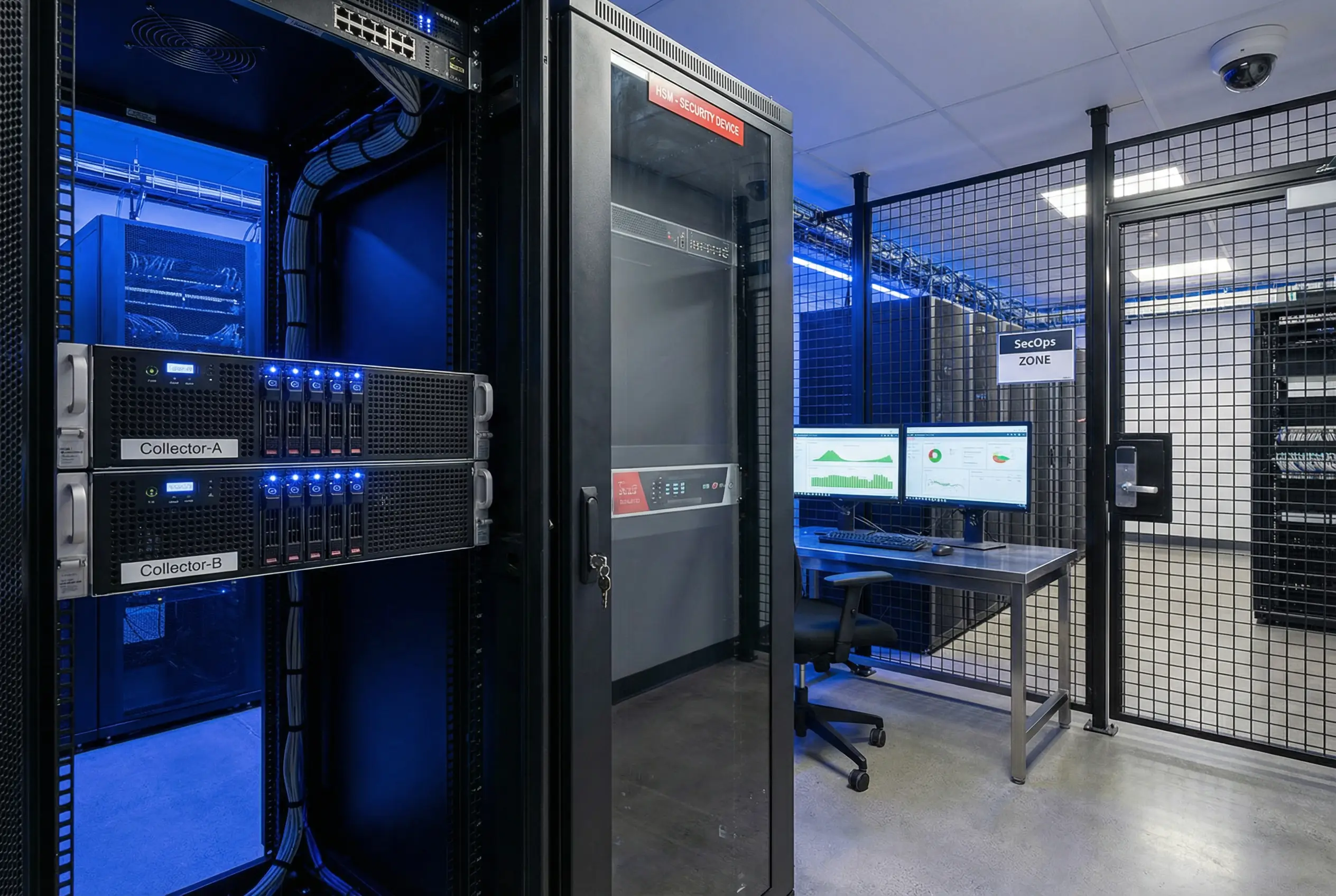
The deployment uses two Zone Collectors in active-active configuration within the production zone, with an HSM device in a separate locked rack for key management. The SecOps zone is physically separated by a cage barrier with electronic access control. The audit workstation has read-only access to the compliance vault and is used exclusively for quarterly log reviews and evidence export requests. All administrative actions on the vault require dual approval and are logged to a separate immutable admin audit store.
| Design Dimension | Requirement | Implementation | Acceptance Test |
|---|---|---|---|
| Immutability | Storage-level WORM lock | NetApp SnapLock or S3 Object Lock Compliance mode | Attempt early deletion; verify rejection |
| Key Management | HSM-backed, dual control | Dedicated HSM appliance, separate from storage admin | Key rotation audit log review |
| Access Control | SoD: ops ≠ audit ≠ admin | RBAC matrix with quarterly access review | Role conflict check report |
| Evidence Export | Chain-of-custody manifest | Signed export package with hash manifest and timestamp | Export drill with legal team |
Cloud-native SaaS platforms present unique challenges for log security: logs from multiple tenants share the same infrastructure, API-based log sources require pull-based collection, and the platform itself must demonstrate to each tenant that their logs are isolated and protected. The Kubernetes-native deployment uses DaemonSet log exporters for container logs and API pull workers for cloud provider audit trails (AWS CloudTrail, Azure Activity Logs).
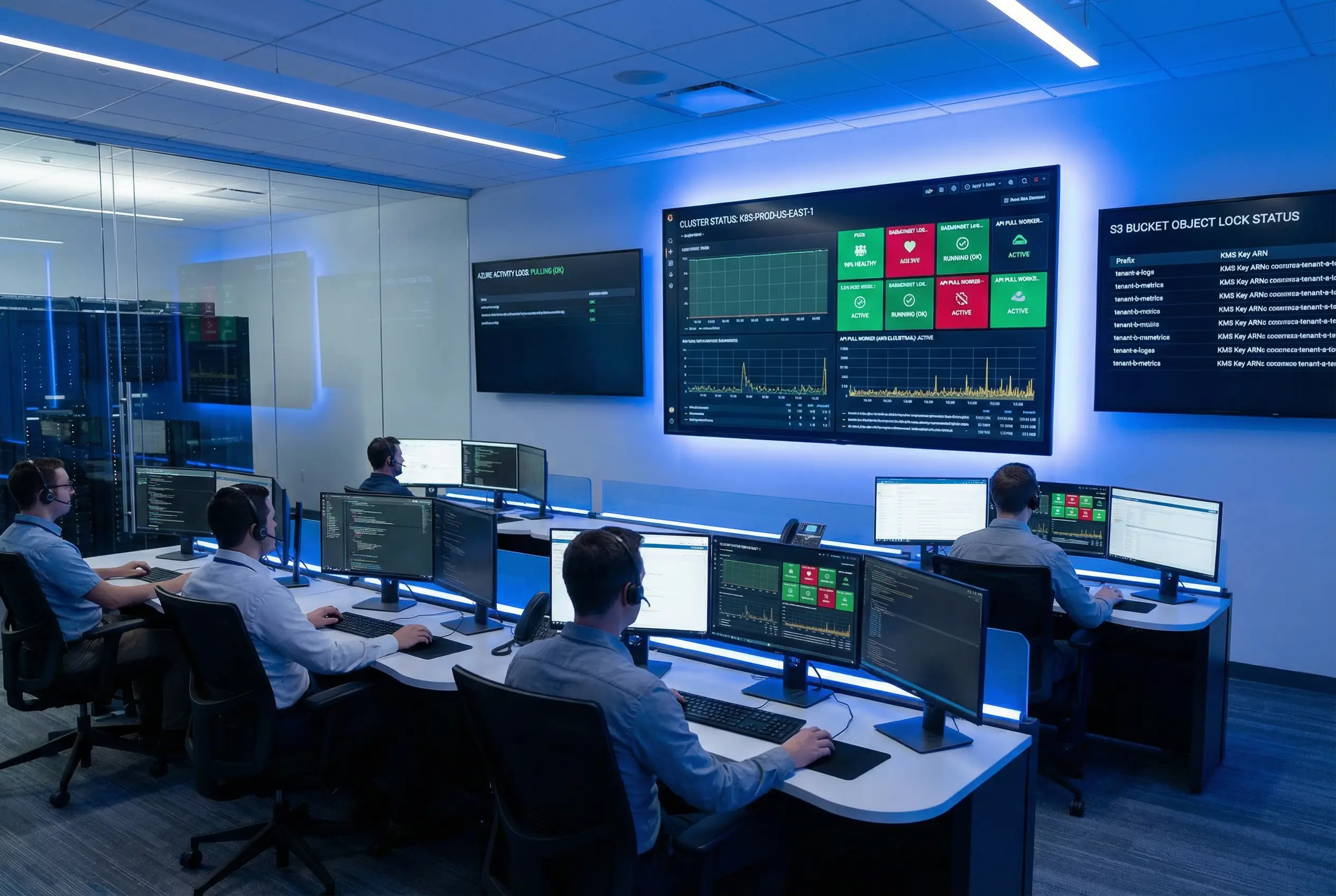
Tenant isolation is enforced at three levels: storage prefix (each tenant's raw logs are stored under a separate S3 prefix with a dedicated KMS key ARN), network policy (Kubernetes NetworkPolicy prevents cross-tenant log access), and RBAC (each tenant's support team can only access their own log namespace). The Object Lock status dashboard is monitored continuously to ensure that no tenant's lock configuration has been inadvertently modified.
Industrial environments present the most constrained log collection challenge: OT systems (PLCs, SCADA, HMIs) often cannot run agents, have limited network connectivity, and operate in environments with high vibration, temperature, and electromagnetic interference. The DMZ collector model uses a ruggedized industrial-grade appliance in a dust-proof enclosure to bridge the OT and IT networks through a strictly controlled DMZ.
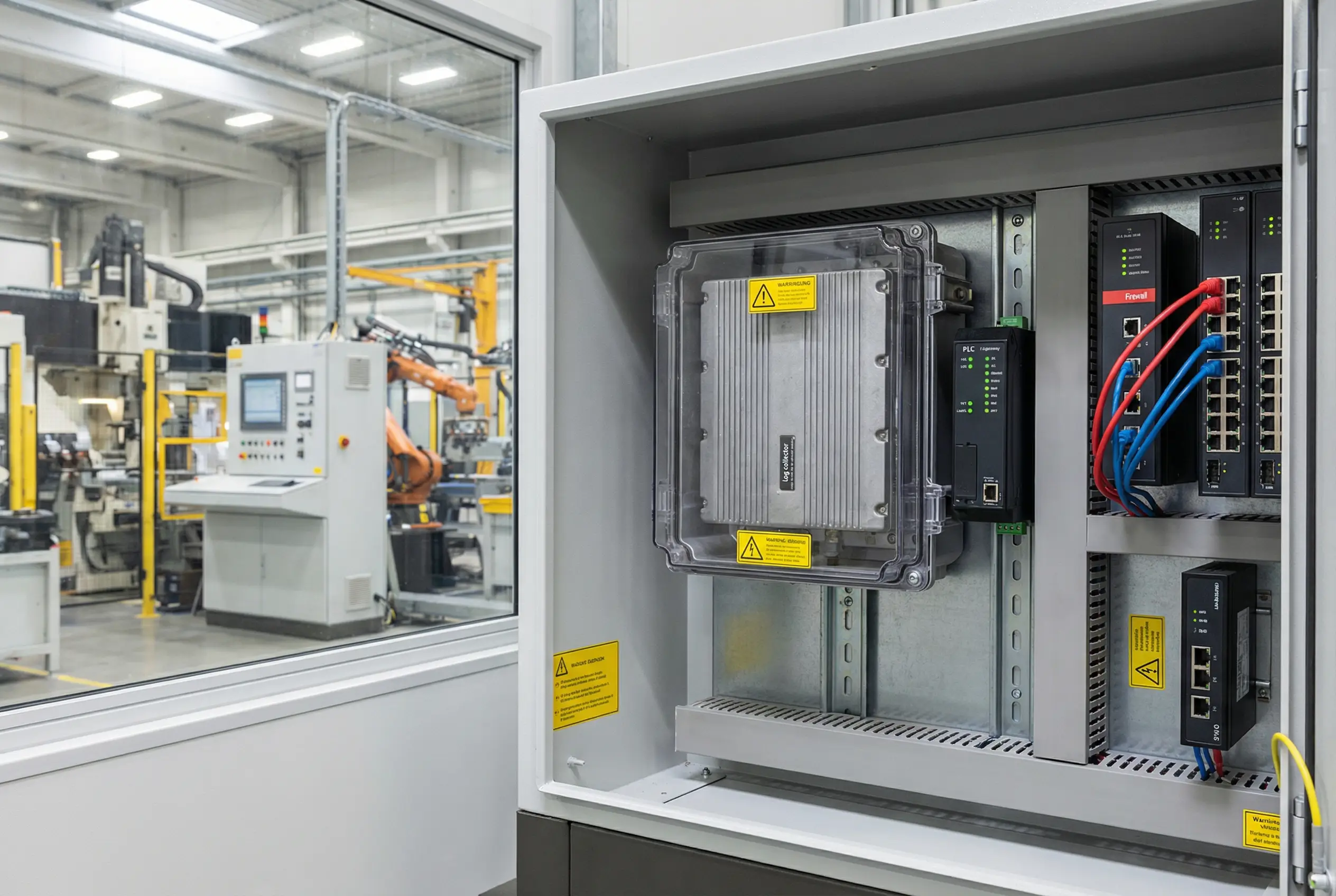
The ruggedized collector appliance is mounted on a DIN rail inside the electrical cabinet, adjacent to the PLC gateway and industrial firewall. It receives syslog from OT devices over the internal OT network and forwards only approved log types through the industrial firewall to the IT-side VPN router. The firewall enforces a strict allowlist of source IP addresses, destination ports, and log formats. No inbound connections from the IT side are permitted to the OT network.
Government agencies operating multi-level security (MLS) environments must collect logs from networks at different classification levels (Unclassified, Confidential, Secret) while maintaining strict separation between them. The air-gapped vault for the Secret zone means that logs from the highest classification level are never transmitted over any network — they are collected locally and transferred via a one-way data diode or physical media with chain-of-custody controls.
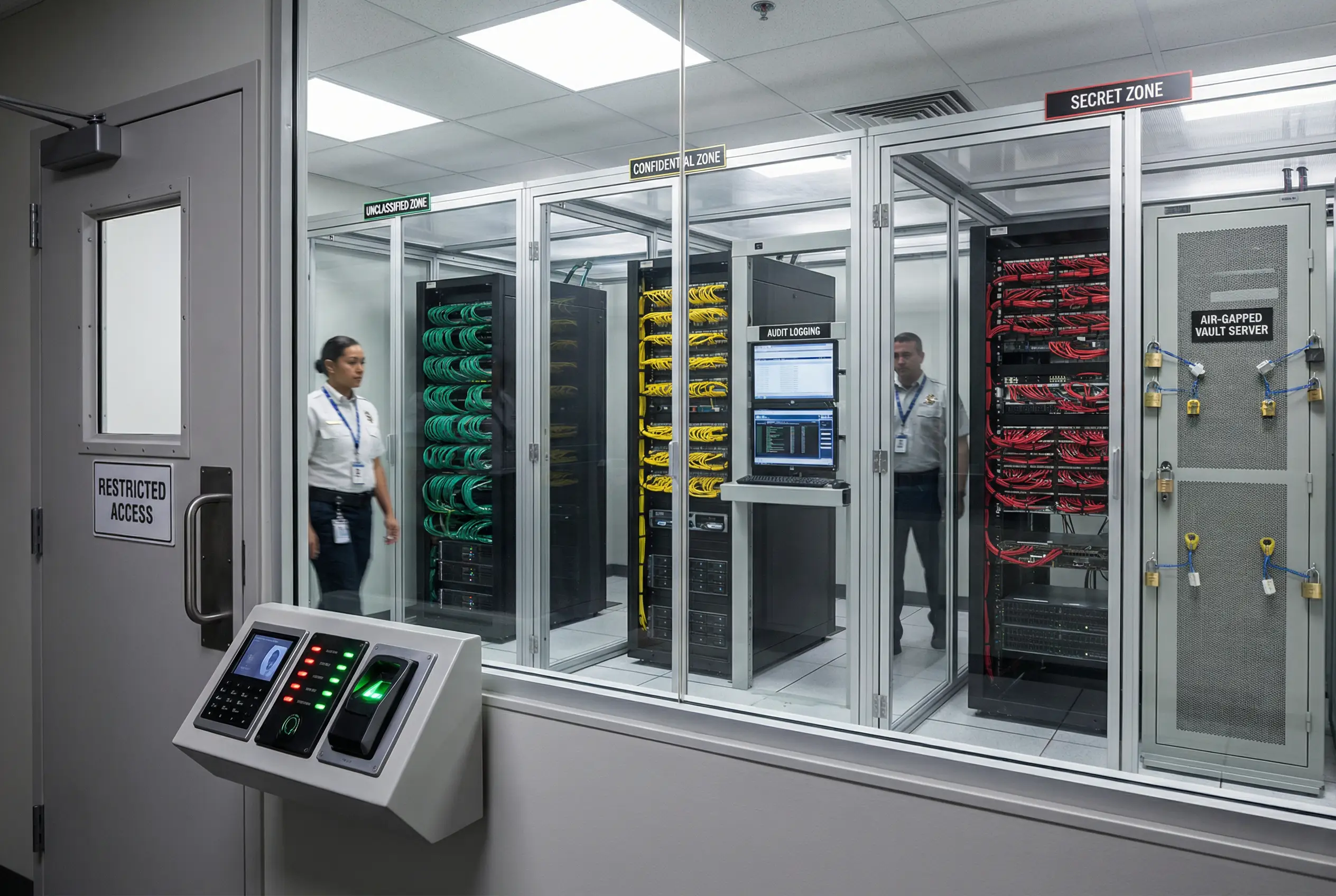
The physical separation is enforced through color-coded cable management (green for Unclassified, yellow for Confidential, red for Secret), separate locked rack enclosures for each zone, and a biometric access control panel at the entrance. The audit gateway appliance between the Confidential and Unclassified zones enforces one-way data flow using a hardware data diode. The air-gapped vault server in the Secret zone has physical tamper-evident seals and requires two-person access for any maintenance.
Healthcare providers must balance two competing requirements: comprehensive audit logging of all access to protected health information (PHI) for HIPAA compliance, and privacy protection that prevents the audit logs themselves from becoming a secondary PHI exposure risk. Field-level tokenization replaces patient identifiers in log records with deterministic tokens that can be reversed only by authorized personnel with access to the tokenization vault.
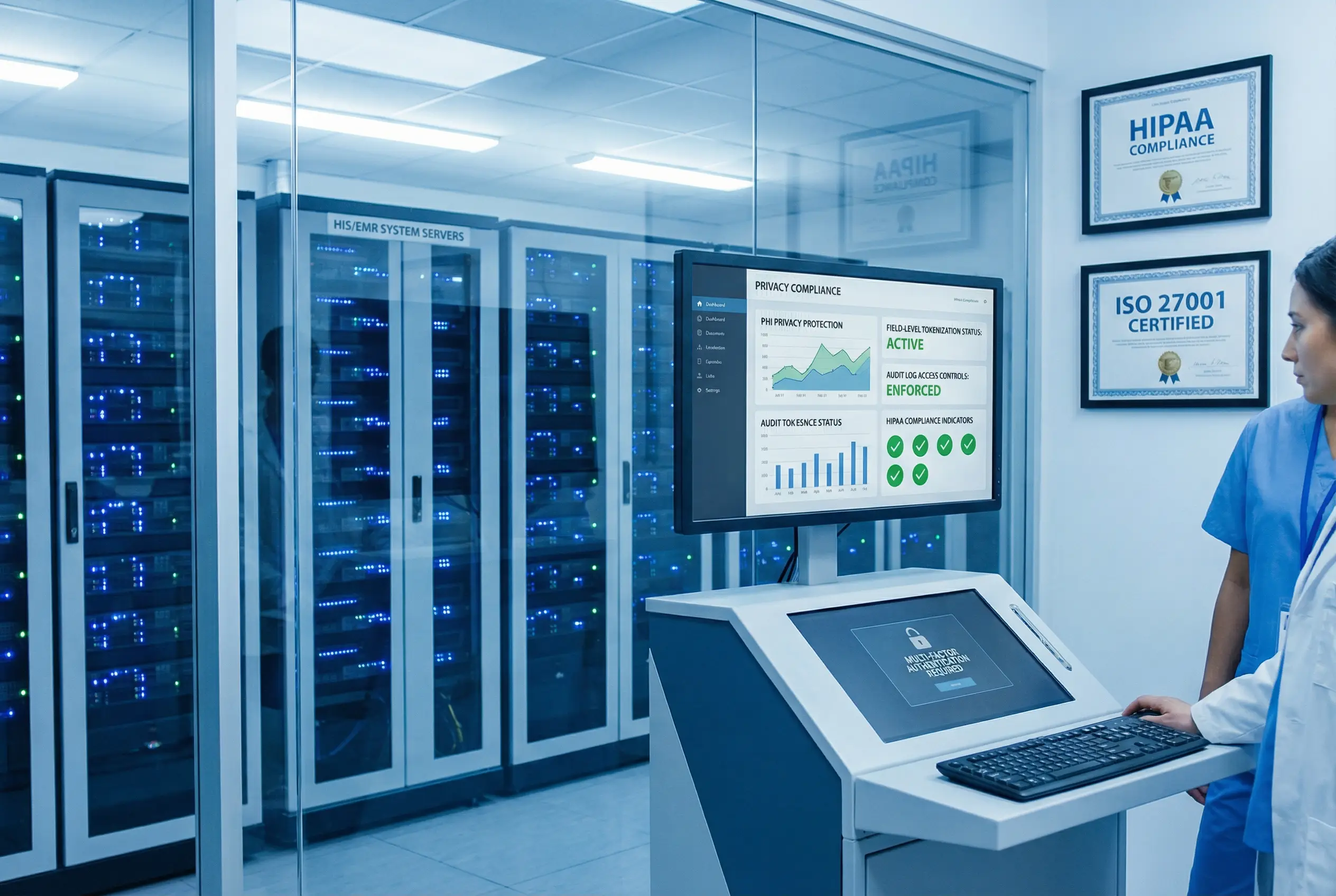
The privacy compliance dashboard provides real-time visibility into tokenization status, audit log access controls, and HIPAA compliance indicators. The MFA-protected audit workstation is the only terminal from which de-tokenized log records can be accessed, and all access is logged with the requesting clinician's identity, the patient record accessed, and the business justification. HIPAA and ISO 27001 compliance certificates are maintained and displayed as part of the physical security posture.
Retail and e-commerce organizations must implement PCI DSS Requirement 10 for log management within the Cardholder Data Environment (CDE). This requires daily log review, centralized log collection, protection against log modification, and retention of at least 12 months with 3 months immediately available. The quarterly log review process must be documented and evidence must be available for QSA assessment.
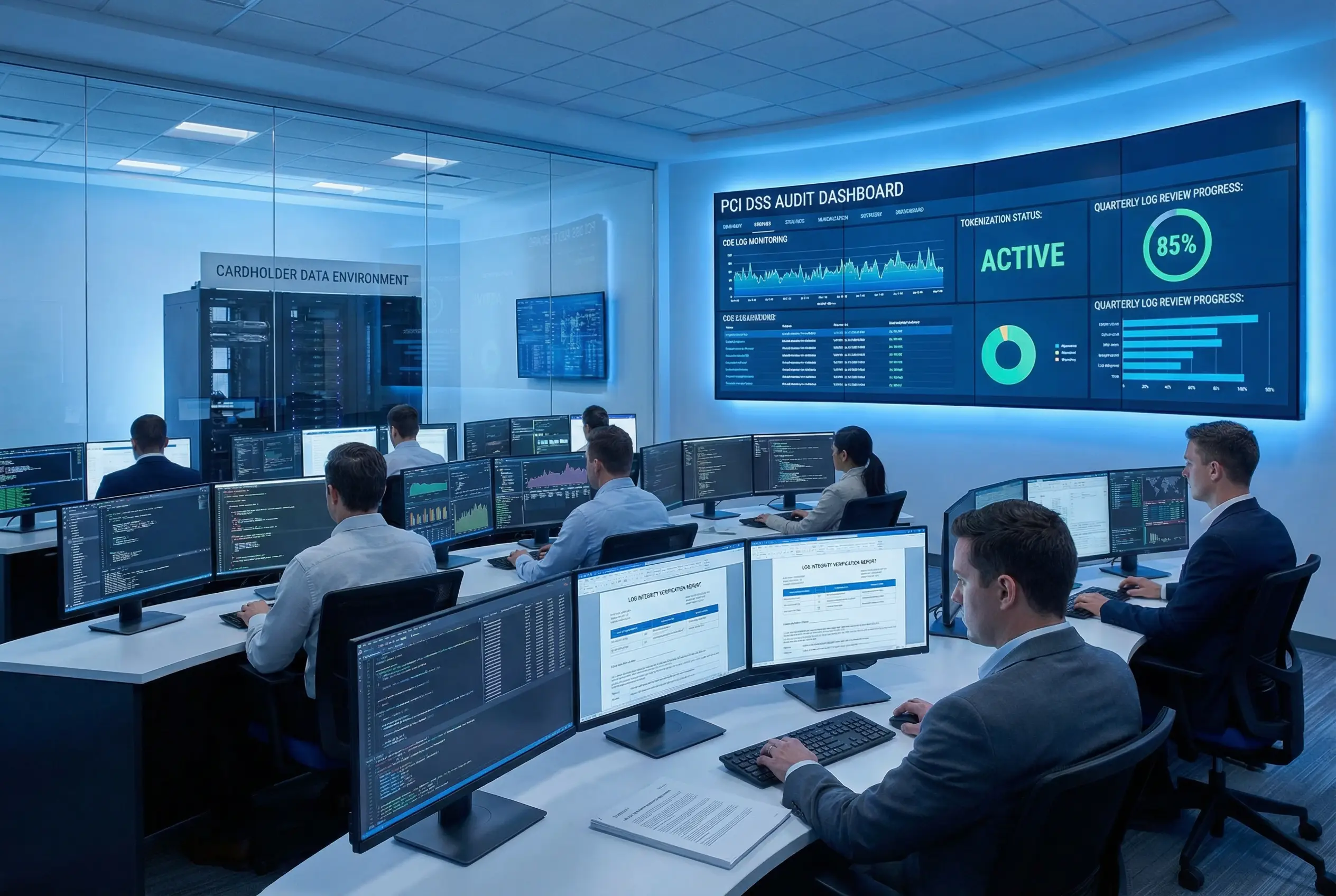
The PCI DSS audit dashboard provides a consolidated view of CDE log monitoring status, tokenization health, and quarterly review progress. The cardholder data environment is physically separated from the general corporate network through a dedicated rack enclosure visible through the glass partition. Security analysts perform daily log reviews against a defined baseline of expected events, and any anomalies are escalated through the incident response process with log evidence packages attached.
Telecommunications companies and ISPs operate at a scale that requires distributed collector clusters across multiple geographic regions, with centralized aggregation and immutable storage. The primary challenge is not just volume but geographic distribution: collectors in different regions must maintain synchronized time, consistent hash chain continuity, and reliable delivery despite variable WAN latency. The NOC provides a unified operational view across all regions.

The NOC video wall displays real-time log ingestion rates, collector health status across all geographic regions, and network topology with active log streams highlighted. The geographic distribution of collectors (NA, EU, APAC) ensures that regional network outages do not cause global log loss — each region's collectors buffer locally and replay when connectivity is restored. The centralized aggregation platform uses a distributed queue architecture to handle burst traffic during network events.
Law firms and digital forensics service providers require the highest standard of evidence chain integrity — logs must be demonstrably unmodified from the moment of collection to the moment they are presented in court. This requires not just technical immutability but a documented chain-of-custody process that can withstand cross-examination by opposing counsel. Every access to the evidence, every export, and every verification must be recorded with the identity of the person performing the action.
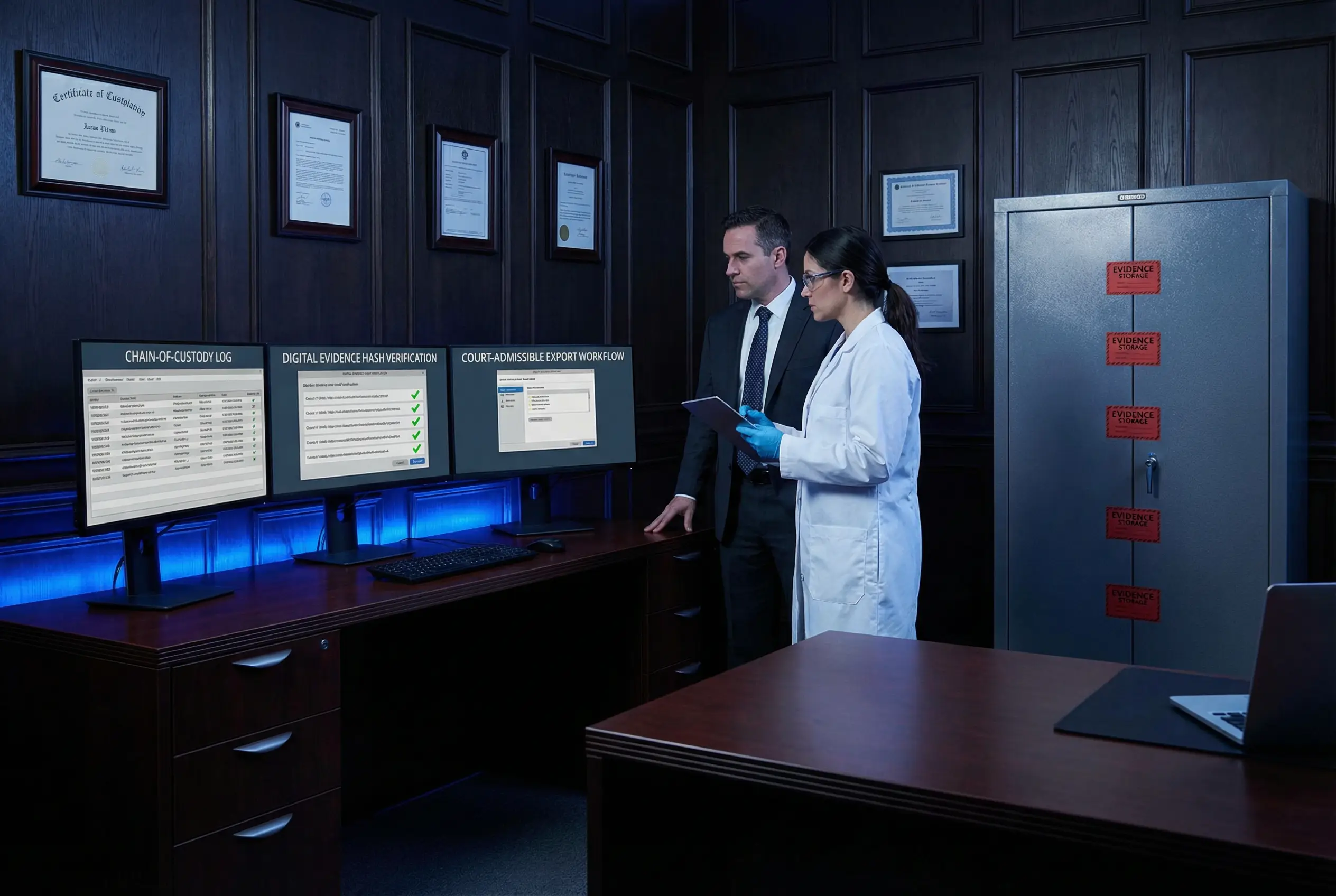
The evidence management workstation displays three parallel workflows: the chain-of-custody log showing every access event with timestamps and identities, the digital evidence hash verification interface confirming integrity against stored manifests, and the court-admissible export workflow that packages evidence with a signed hash manifest and a notarized timestamp. The physical evidence storage cabinet uses tamper-evident seals that are photographed and recorded before and after each access.
3.2 Scenario Selection Guide
The table below provides a structured comparison of the eight scenarios across the key design dimensions that drive deployment decisions. Use this table to identify which scenario or combination of scenarios best matches your organization's requirements, then refer to the corresponding scenario section for detailed technical parameters and acceptance criteria.
| Scenario | Industry | Primary Threat | Compliance | EPS Range | Key Design Choice |
|---|---|---|---|---|---|
| A | Financial | Insider admin | SOX / PCI DSS | 5K–15K | HSM + dual data center + SoD |
| B | Cloud SaaS | Tenant isolation breach | SOC 2 / ISO 27001 | 2K–20K | Per-tenant Object Lock + KMS |
| C | Manufacturing | OT/IT lateral movement | IEC 62443 | 50–500 | DMZ collector + data diode |
| D | Government | Classification breach | FISMA / NIST 800-53 | 500–5K | Air-gap + physical seals + 2-person |
| E | Healthcare | PHI exposure via logs | HIPAA / HITECH | 1K–8K | Field tokenization + MFA access |
| F | Retail | CDE log tampering | PCI DSS v4.0 | 2K–10K | Daily review + quarterly QSA evidence |
| G | Telecom | Volume/geo outage | CALEA / GDPR | 50K+ | Distributed cluster + GPS NTP |
| H | Legal | Evidence admissibility | Court standards | 100–2K | Chain-of-custody + notarized export |